By Jason Clinch, Three Creeks Consulting LLC, February 26, 2026
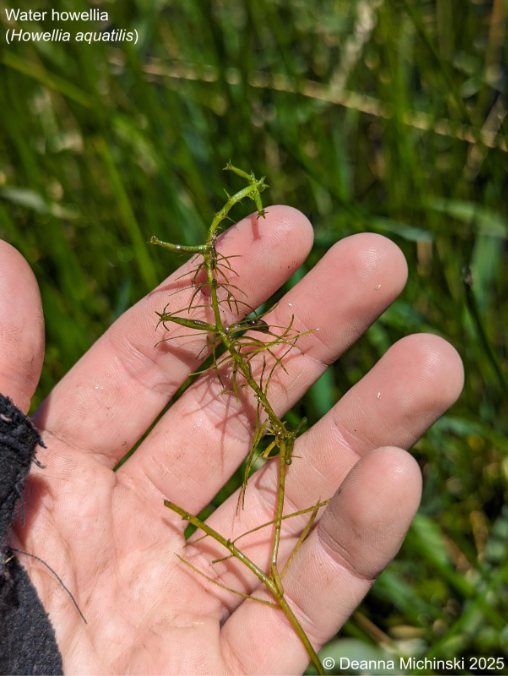
“Is this Water Howellia?” Deanna asked as she held up some stringy bits of pondweed she had just pulled from a mucky pool of water in the middle of a cattle pasture. It was an unusually warm late May day and Rick and I had just sat down moments before. I jokingly said to them “I found us a lunch spot with a view of the water…”. That “view” was of a swampy pasture still holding water at the end of May but sure to dry out in the next few weeks. Much of the vegetation had been grazed down earlier in the spring and was only beginning to recover since the cattle had been removed just a couple of weeks before our visit. From our lunch spot vantage point a few feet away, the vegetation looked to be mostly non-native and even invasive pasture grasses, including the nefarious reed canarygrass (Phalaris arundinacea), with some native sedges (Carex sp.) and rushes (Juncus sp.) mixed in. While avoiding the dried cow “pies” in our seating arrangement, Rick said perhaps somewhat sarcastically, “That looks interesting”. In hindsight, it was not sarcasm, it was premonition…
Throughout the spring of 2025, we had been inventorying vascular plants for the Columbia Land Trust on a property they own on Deer Island in Columbia County, Oregon. The preserve is referred to as the Columbia Stock Ranch, a roughly 600-acre parcel abutting the Columbia River, which historically was used intensely as cattle pasture but now is only grazed seasonally as a tool for managing vegetation. To say the least, Water Howellia was not high on our BINGO card of species we anticipated finding…
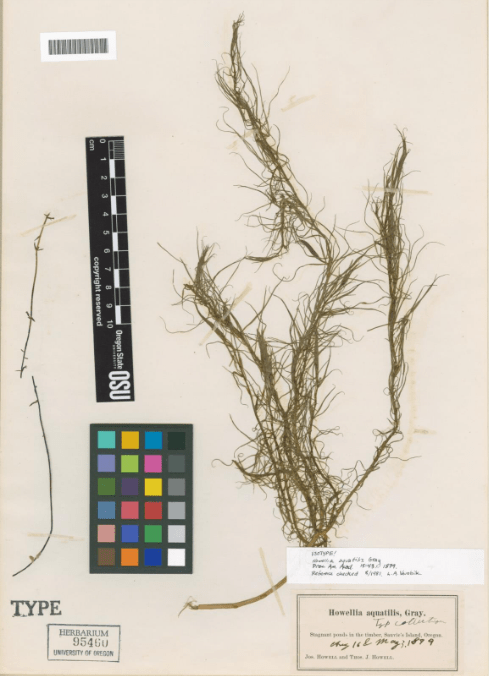
With the scientific name of Howellia aquatilis, one can surmise that it inhabits “aquatic” habitats but what about the genus, Howellia? The genus is monotypic (meaning having only one species within the genus) and was named after the brothers, Thomas and Joseph Howell, early Oregon botanists who first “discovered” the plant on Sauvie Island in 1878. Several more collections of Water Howellia were made from Sauvie Island (and near Lake Oswego and Salem) by different botanists in the thirty or so years following its discovery and the habitat it was generally found in was often described as “stagnant ponds in the timber”1 or something similar. Back in 1878, much of Sauvie Island was likely a mix of bottomland “timber” composed of cottonwood (Populus trichocarpa) and Oregon ash (Fraxinus latifolia) with areas of wet prairie and marsh heavily influenced by the Columbia River. Anyone who has visited the island knows that there are plenty of “stagnant ponds” scattered throughout the remaining forested bottomlands as well as around the contemporary farms and pastures that may have been once historically “timbered”. However, since Sauvie Island is dissected by the line separating Multnomah County from Columbia County, we are unsure which county(s) these collections of Water Howellia were made from. One can surmise that they were probably from both. Nearly 75 years went by without it ever being seen again in Oregon, and by all accounts, it had been extirpated from the state…
I was dumbfounded by Deanna’s question. My answer was something along the lines of “No…yes…maybe…no way…no <expletive> way!…it can’t be?!?” even though my brain was very much telling me “YES you idiot”!
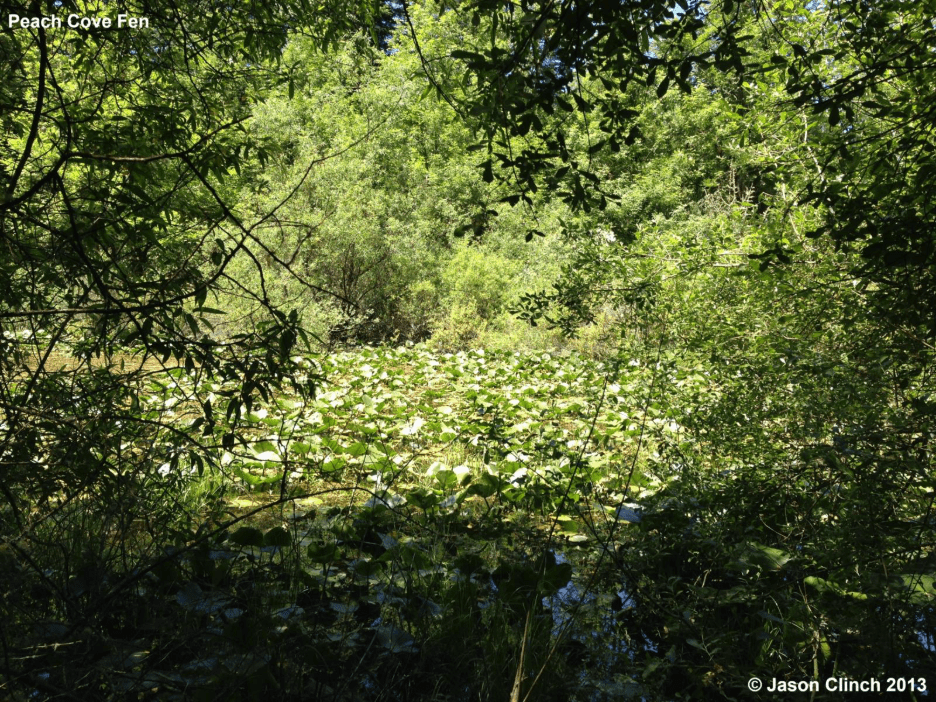
I had seen this Water Howellia before, several times to be exact, but it had been a while and in vastly different habitat than where we were on this day. I attended a workshop about the species shortly after it had been “rediscovered” in 2013 at Metro’s Peach Cove Fen2, a natural area near West Linn. We learned during the workshop that Water Howellia had been found at William L. Finley National Wildlife Refuge back in 2002 but efforts to relocate it in the years since were unsuccessful. During the workshop, we visited what we were told was the last remaining “fen” habitat in the Willamette Valley. Occupying a depression within bedrock scoured out by the Missoula Floods, the fen is fed by groundwater and precipitation, with a floating peat mat that rises and falls with the water level. It is a wildly interesting place to visit for ANY biologist or botanist. Water Howellia was generally found around the shaded shallow edges of the fen and in other nearby shallow wetland ponds also well-shaded by adjacent trees. Some describe these geologic features as “kolk ponds or lakes”; kolk meaning “underwater vortex created by water rushing rapidly by an obstacle”3. Sounds just like something the Missoula Floods would have created!
Filled with immediate enamor for the plant and its unusual habitat during the workshop, I quickly volunteered to monitor the known population of Water Howellia at Ridgefield National Wildlife Refuge in Washington with Rare Care, a University of Washington rare plant monitoring program (and inspiration for Citizen’s Rare Plant Watch). I teamed up with my friend Ron for this assignment, and we learned through visiting this population that it also inhabits shady, shallow wetland ponds carved out of bedrock during the Missoula Floods on the refuge. Both Oregon ash and Oregon white oak (Quercus garryana var. garryana) were water’s-edge associates along with Douglas spiraea (Spiraea douglasii var. douglasii) with this population.
While I have not been to Turnbull National Wildlife Refuge near Cheney, Washington, where Water Howellia is also known to occur, that area was the epicenter of the Missoula Floods many times through, having left long, linear depressions in the bedrock that fill with water seasonally…
As Rick got to work looking for more specimens in the wetland, I stared back at the swampy cattle pasture in front of me trying to bend my head around the idea that this was somehow Water Howellia habitat. Insisting that it was not, I trusted that my ever-present Hitchcock and Cronquist would steer me in the right direction as to what this pondweed Deanna was holding might be. I refused to trust what Google Lens, Siri, iNaturalist and every other AI app we put to work was telling us…It simply could not be!
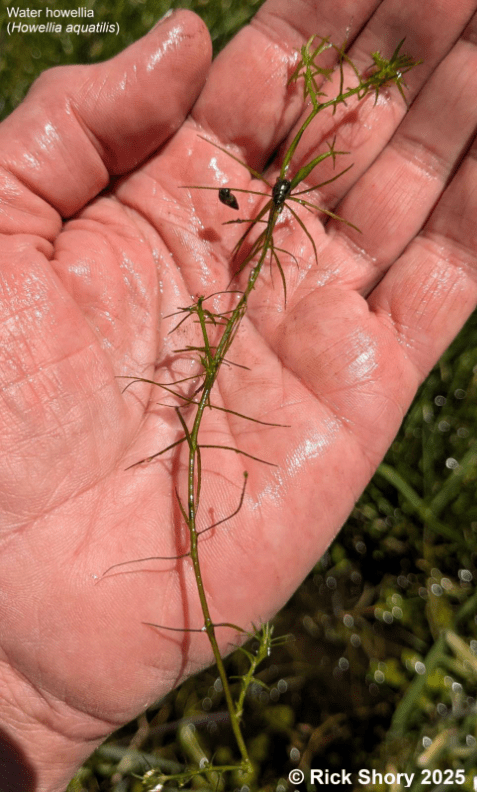
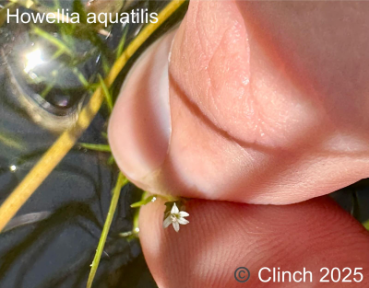
Water Howellia is in the Bellflower family (Campanulaceae) but lacks the broad, bell-shaped flowers the family is named for. It more closely resembles those species found in the Lobelioideae subfamily of Campanulaceae (formerly Lobeliaceae). Curiously, Water Howellia has two types of flowers; submerged, cleistogamous (self-pollinating) flowers; and emergent, chasmogamous (cross-pollinating) flowers. The earlier cleistogamous flowers are found in the axils of long, narrowly-linear leaves (1-4.5 cm long and up to 1.5 mm wide), lack a conspicuous corolla, and remain closed as they mature into the longish, slightly banana-shaped, fruiting capsules (0.5-1.3 cm long). The later maturing chasmogamous flowers are borne on short, stout pedicels (1-4 mm long) with shorter and more or less vertical leaves near the branch tips. The tiny, tubular, bi-lateral symmetric corollas are pale lavender to whitish with 5 deeply cleft, strap-like lobe tips (<1.5mm long).
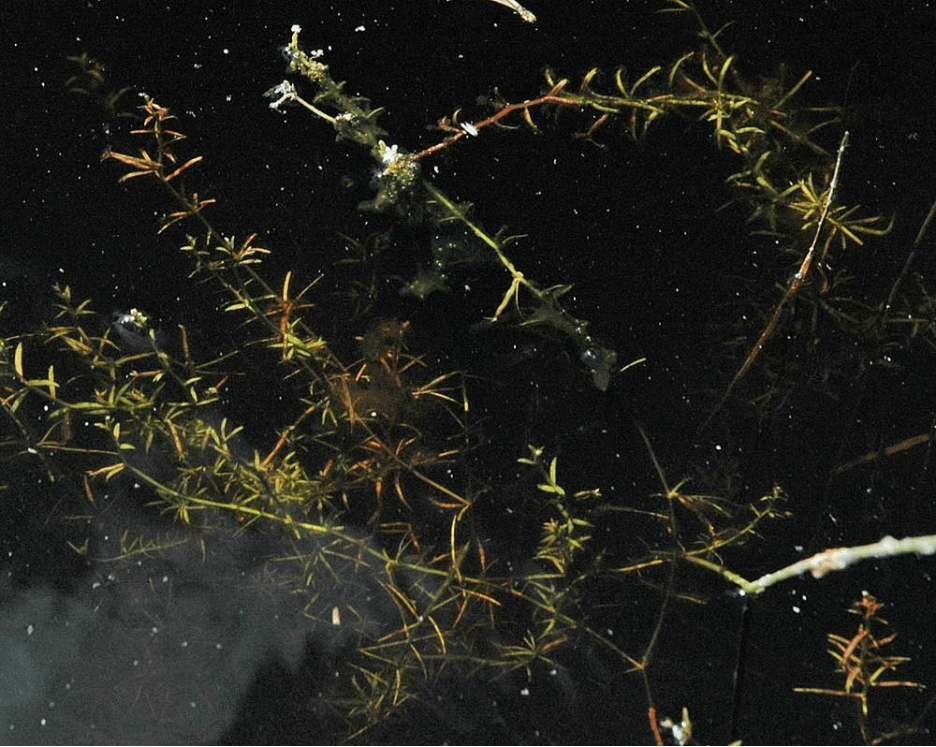
Vegetatively, Water Howellia is similar to many other aquatic species it sometimes occurs with, particularly Potamogeton (pond weed) and Callitriche (water starwort) species. Its leaves are typically arranged alternately along the simple to sometimes many-branched stem, arising from a fibrous root system. It almost always floats in or at the top of the water column, and occasionally, broken pieces can be found seemingly alive and fertile. As the water recedes, Water Howellia (along with its similar associates) begins to decompose, making it much harder to identify except for its distinguishing fruits. Eventually, even these disintegrate, releasing their tiny (2-4 mm) seeds over the remainder of the season.
As an annual, Water Howellia seeds typically germinate in late fall and/or early winter in areas of bare ground as their habitats wet up and eventually become inundated. Seedlings over-winter underwater through early spring, maturing into fertile plants by mid- to late-spring as the water warms and precipitation slows. Depending on precipitation, weather conditions, and how fast the water recedes, Water Howellia can be found blooming generally in May and June but sometimes as late as August.
After settling into the realization that Deanna had indeed just found this rare species (and celebrating with smiles, high-fives, and overall giddiness), we began surveying the rest of the wetland to document the full extent of this new population. We quickly found much more Water Howellia co-mingling with the other aquatic and emergent vegetation in the wetland. We briefly investigated the same wetland on the other side of the fenceline where cattle had been excluded from grazing but found no Water Howellia. This area was a turf of reed canarygrass that nearly excluded any other herbaceous vegetation.
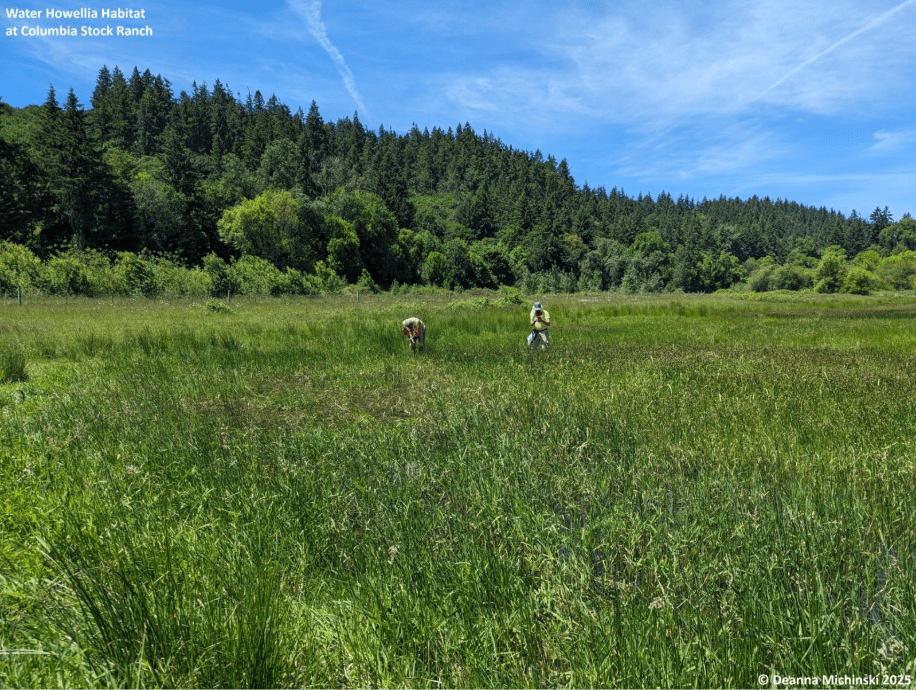
Subsequent visits to the Columbia Stock Ranch in June turned up no more Water Howellia, although more potential habitat for this species is certainly present. The warm, dry spell at the end of May and early June had really accelerated the growing season and dried things up quickly. Water in the wetland where we had found Water Howellia originally had dropped from a depth of up to 16-inches or so, to just a scant couple of inches in the deepest parts.
Nonetheless, as important and exciting as it was to discover a second known extant population in Oregon, the realization that Water Howellia may very well tolerate a much broader category of habitats (and disturbance) than just Missoula Flood-related scablands and kolks was just as interesting. Seasonally wet pastures and ponds that are also grazed by cattle are seemingly plentiful in the bottomland areas and islands of the lower Columbia River corridor. As such, the potential for discovering new populations in similar habitats as those occurring at the Columbia Stock Ranch would seem to be plausible, and further surveys are certainly needed.
Many thanks to Deanna Michinski and Rick Shory who assisted with this project. Without their help and support, I might still be pawing through my Hitchcock and second guessing myself!
— Jason Clinch

References
Oregon Biodiversity Information Center (ORBIC). 2023A. Biotics rare species database. Institute for Natural Resources. Portland State University, Portland, Oregon. Accessed February 2023.
Oregon Department of Agriculture. 2021. Plant conservation fact sheet: https://www.oregon.gov/oda/plant-conservation/Pages/listed-plants.aspx.
OregonFlora. 2019. Rare Plant Fact Sheet for Water Howellia: https://oregonflora.org/pages/content/howaqu.pdf.
OregonFlora. 2025. Website: https://oregonflora.org/taxa/index.php?taxon=5665.
U.S. Fish and Wildlife Service. 2025. Environmental Conservation Online System: https://ecos.fws.gov/ecp/.
Footnotes
- From the isotype herbarium collection (Catalog #: OSC0000428) by Thomas and Joseph Howell held at the Oregon State University Herbarium. Available here: https://oregonflora.org/collections/individual/index.php?occid=1084168. ↩︎
- Peach Cove Fen Natural Area Site Conservation Plan. May 2014. Available here: https://rim.oregonmetro.gov/WebDrawer/Record/438536/File/document. ↩︎
- Wikipedia contributors. (2024, June 3). Kolk (vortex). In Wikipedia, The Free Encyclopedia. Retrieved 18:18, November 8, 2025. Available here: https://en.wikipedia.org/w/index.php?title=Kolk_(vortex)&oldid=1227063676. ↩︎
 Three Creeks Consulting